Vacuum Brooms and the Victorian Origins of Vacuum Cleaning
·Revised
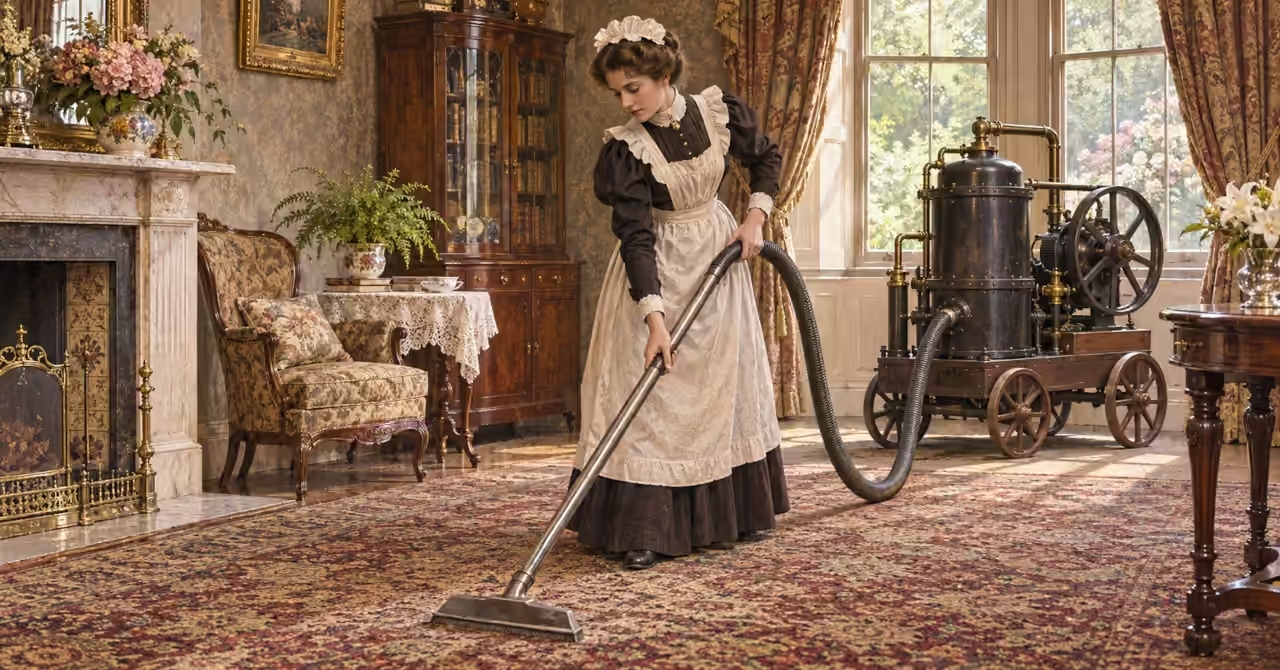
Victorian households had a dust problem long before they had a vacuum cleaner. Carpets trapped soot, ash, hair, crumbs and street dirt, while ordinary sweeping could simply move fine dust from one place to another. Heavy rugs could be carried outside and beaten, but fitted carpets and large interiors made that labour increasingly awkward.
The eventual answer seems obvious to us: instead of striking or sweeping dust loose, pull air through the surface and carry the dust away with it. Yet that simple principle took decades to become a practical household machine. The history of the so-called vacuum broom is therefore less a story of one invention than a chain of increasingly workable answers.
Before the Vacuum Cleaner: Beating, Brushing and Sweeping
For much of the nineteenth century, carpet care depended on mechanical action. Brooms moved surface dirt, carpet sweepers used rotating brushes, and removable rugs could be taken outdoors and beaten. These methods worked, but they had an obvious weakness: fine dust was difficult to capture. Cleaning could become an exercise in dislodging dirt and redistributing some of it into the air.
This domestic problem belongs beside other Victorian attempts to make the home more manageable through systems and equipment. Phillaneum's article on the Victorian washstand, for example, shows how ordinary routines were shaped by the infrastructure available inside the house. Vacuum cleaning would eventually add another layer of hidden domestic infrastructure: airflow, hoses, pumps, filters and later electricity.
Daniel Hess, 1860: Suction Before the Vacuum Cleaner
One of the most interesting early steps came from Daniel Hess of West Union, Iowa. His 1860 United States patent, No. 29,077, described a carpet-sweeping machine with a rotating brush, but it also proposed drawing fine dust through the machine with a current of air and forcing that dust into water. In modern language, it combined agitation, airflow and dust separation.
Hess did not create the familiar powered vacuum cleaner. His machine belonged to the carpet-sweeper tradition, and its air-moving mechanism was mechanical rather than a compact electric fan. What matters is the principle. By 1860, an inventor was already trying to solve the problem that defines vacuum cleaning: how to entrain dust in moving air and then stop that dust from simply returning to the room.
Victorian or Edwardian?
The distinction matters here. Queen Victoria died on 22 January 1901 and Edward VII succeeded her the same day. Hubert Cecil Booth's famous vacuum-cleaner patent dates from later in 1901. The roots of suction cleaning are therefore genuinely Victorian, but the first effective powered British vacuum cleaner belongs, strictly speaking, to the opening months of the Edwardian era.
That makes the technology a useful boundary object: a Victorian problem and set of experiments crossing almost seamlessly into an Edwardian commercial machine.
Hubert Cecil Booth, 1901: Make the Air Move the Other Way
The decisive change came with British engineer Hubert Cecil Booth. According to the Science Museum Group, Booth watched a demonstration of a machine that cleaned by blowing dust away with compressed air. His insight was to reverse the process: suck the dust into a machine and trap it in a filter.
Booth's 1901 patent for extracting dust from carpets and other materials describes suction applied through a cleaning implement while dust was separated from the moving air. The early commercial machines were not neat domestic appliances. They were large, petrol-powered units that could be stationed outside a building while long hoses were fed through doors and windows.
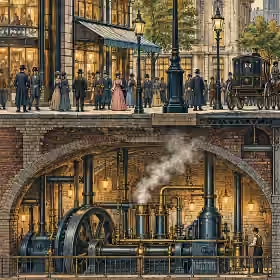
That scale explains why early vacuum cleaning looked more like a service than an appliance. The expensive machinery could remain outside while only the hose and cleaning head entered the room. In effect, the vacuum source was centralised and the person inside handled a comparatively simple tool.
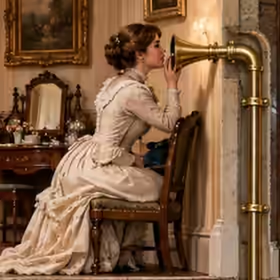
This is the part of the old “vacuum broom” idea that still feels surprisingly modern. Separate the heavy machinery from the user, move air through a flexible hose, and make the hand-held component little more than a nozzle or floor head. The same systems logic appears elsewhere in Victorian engineering, where services were distributed through networks rather than carried as self-contained devices. Phillaneum explores similar thinking in five Victorian technologies that still make mechanical sense.
What Was a “Vacuum Broom”?
The phrase vacuum broom was never a single, perfectly standard technical category. It could describe a floor-cleaning head or portable cleaning apparatus that combined the familiar action and shape of a broom with suction. That ambiguity matters, because surviving designs differ considerably in how they produced the airflow.
A useful example is Walter Griffiths's 1905 British patent for “Vacuum Apparatus for Removing Dust from Carpets and for other like purposes.” Griffiths proposed a portable box containing two exhausting bellows operated by foot. A flexible hose led to interchangeable nozzles, while a filter bag and screen kept dust from entering the bellows.
That design is much closer to the literal idea of a vacuum broom than Booth's street-side machine. The operator could move the apparatus through a building and work the suction mechanism without an electric motor. It was still labour, but it concentrated that labour into pumping rather than carpet beating.
How Early Suction Cleaning Actually Worked
The original article described vacuum brooms as though all of them contained a motor, fan and dustbin. That is true of many later vacuum cleaners, but it is anachronistic for the early machines. The historic designs used several different ways to create the required pressure difference.
Mechanically, however, the important chain was already recognisable:
- A nozzle or brush head admitted air close to the dirty surface.
- A hose or passage carried dust-laden air away from the carpet.
- An air mover — bellows, pump or powered machinery — created the pressure difference that sustained the flow.
- A separator or filter retained dust while allowing air to continue through the system.
- An exhaust path returned the cleaned air or expelled it elsewhere.
Modern cleaners add far better motors, filtration, seals, brush rolls and airflow control, but the underlying architecture is remarkably stable. The important Victorian-era leap was to stop thinking of dust solely as something to sweep and start treating it as something that could be transported in an engineered air stream.
From Cleaning Service to Household Appliance
Booth's machine demonstrated that suction cleaning could work effectively, but size, cost and power supply stood between the idea and ordinary households. Portable designs such as Griffiths's reduced the machinery, while the rapid development of small electric motors opened another route.
The Science Museum Group credits James Spangler in Ohio with a 1907 broomstick-like electric cleaner that used suction from an electric fan, a cloth filter and a dust-collection bag. Spangler sold his idea to William Hoover in 1908. The familiar domestic vacuum cleaner therefore emerged not from one uninterrupted design line, but from the convergence of suction cleaning, portable mechanisms, electric motors and practical dust collection.
Household adoption was not instantaneous. Electricity was unevenly available, machines were expensive, and brushes and carpet sweepers remained useful. The vacuum cleaner became commonplace only as the surrounding system — electrical supply, manufacturing, retailing, maintenance and domestic expectations — caught up with the invention itself.
The Mechanical Idea That Survived
Looking back, the most enduring part of the vacuum broom is not any particular Victorian casing or handle. It is the decision to make controlled airflow do the carrying. Once dust could be lifted into an air stream, the engineering problem could be divided into separate functions: loosen the dirt, move the air, separate the particles and make the machine convenient to use.
That separation of functions is why the lineage from Hess to Booth, Griffiths, Spangler and later manufacturers is more useful than a hunt for a single “first vacuum cleaner”. Each inventor solved a different part of the system. Hess combined sweeping with air draft and water separation. Booth made powered suction the central principle. Griffiths pursued portability with bellows and interchangeable nozzles. Spangler helped bring the motor, filter bag and broom-like form into one electric domestic machine.
The result was not simply a better broom. It was a new way of thinking about cleaning: dirt could be collected by engineering an invisible flow of air.
From the Curator's Workshop
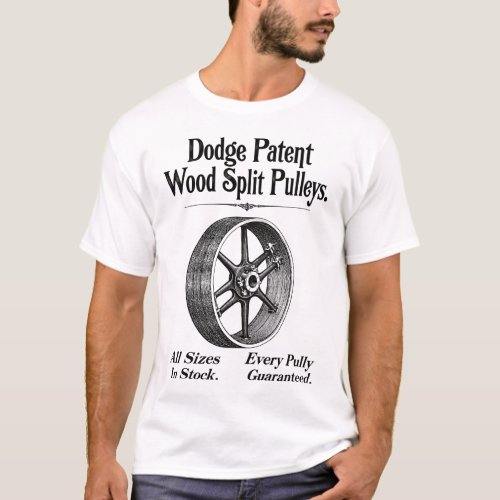
From Victorian vacuum brooms to the ingenious machinery that powered their workshops, the age of invention was full of clever mechanical solutions. Our Dodge Patent Wood Split Pulley T-shirt celebrates that same inventive spirit, featuring a beautifully remastered 1893 industrial advertisement. A distinctive design for engineers, makers and lovers of forgotten technology. Wear a little history, spark a conversation and support Phillaneum with every purchase.
Author's Notes
Notes & Memoranda
As is often the case, the subject extends beyond the bounds of a single article. The notes and memoranda below gather together useful definitions, related observations, references, and occasional curiosities discovered along the way.
Glossary
- Carpet sweeper
- A mechanically operated floor cleaner, commonly using rotating brushes to lift dirt into a receptacle without powered suction.
- Vacuum broom
- A historic descriptive term for broom-like or nozzle-based cleaning apparatus that used suction to remove dust from carpets and similar surfaces.
- Bellows
- A flexible chamber that expands and contracts to move air. Walter Griffiths's 1905 portable vacuum apparatus used two foot-operated exhausting bellows.
- Suction nozzle
- The opening placed near the surface being cleaned. Air accelerates through the nozzle and carries loosened dust into the hose or machine.
- Filtration
- The process of separating collected dust from the moving air before that air reaches the pump or is discharged.
Frequently Asked Questions
Was the vacuum cleaner invented in the Victorian era?
Its roots were Victorian, including Daniel Hess's 1860 suction-assisted carpet sweeper. Hubert Cecil Booth's effective powered vacuum cleaner was patented later in 1901, after Queen Victoria's death, so it is technically an early Edwardian invention.
What did Daniel Hess invent in 1860?
Hess patented a carpet-sweeping machine that used a rotating brush and a draft of air to draw fine dust through the machine, with the dust forced into water. It anticipated important vacuum-cleaning principles without being a modern powered vacuum cleaner.
How did Hubert Cecil Booth's 1901 vacuum cleaner work?
Booth used powered suction to draw dust-laden air through a cleaning implement and hose into a filtering system. His early machines were large units stationed outside buildings, with long hoses fed inside.
What was different about Walter Griffiths's 1905 design?
Griffiths proposed a portable, non-electric machine using two foot-operated exhausting bellows, a flexible hose, interchangeable nozzles and a filter bag. It brought the suction apparatus much closer to the operator.
Further Reading…
References and Further Reading
- Daniel Hess, Carpet-Sweeper, U.S. Patent No. 29,077, 10 July 1860. [Retrieved 1 November 2026]
- Hubert Cecil Booth, Improvements relating to the Extraction of Dust from Carpets and other Materials, British patent application dated 30 August 1901. [Retrieved 1 November 2026]
- Science Museum Group Collection, British Vacuum Cleaner Company Limited, history of Booth's powered vacuum-cleaning system and service model. [Retrieved 1 November 2026]
- Walter Griffiths, Improvements in Vacuum Apparatus for Removing Dust from Carpets and for other like purposes, filed 20 October 1905. [Retrieved 1 November 2026]
- Science Museum Group Collection, Hoover Constellation vacuum cleaner with attachments, background on James Spangler, William Hoover and domestic vacuum-cleaner development. [Retrieved 1 November 2026]
- The Royal Family, Victoria (r. 1837–1901), confirming Victoria's death on 22 January 1901 and the succession of Edward VII. [Retrieved 1 November 2026]
Disclosure
This article is a historical overview of early carpet- and vacuum-cleaning technology. Historic terminology was inconsistent, and “vacuum broom” is used here as a descriptive period term rather than a single standard machine type. The article is not contemporary cleaning, conservation or health advice. Some commercial placements on Phillaneum may use affiliate links; editorial conclusions are independent of those placements.